

Most people know they have found something they shouldn’t disturb. What they don’t know is whether it belongs to wasps or bees, and that question matters more than they realize.
Why the ID Matters Before You Act
Getting this wrong is where things escalate. How you handle a wasp nest and how you handle a bee nest are different in almost every practical way, from who removes it to whether it should be removed at all. Treating the wrong nest the wrong way doesn’t just fail to solve the problem, but makes it significantly worse.
Wrong Move, Wrong Insect
Spraying a honeybee nest with wasp killer risks a defensive response. It also moves the problem rather than solving it. Calling a pest control company to remove a bumblebee ground nest that poses no real threat is unnecessary.
On the other hand, trying to relocate a yellow jacket nest yourself because you assumed it was bees is how serious stings happen. The ID isn’t a formality. It’s the step that determines every other decision.
What Wasp Nests Look Like
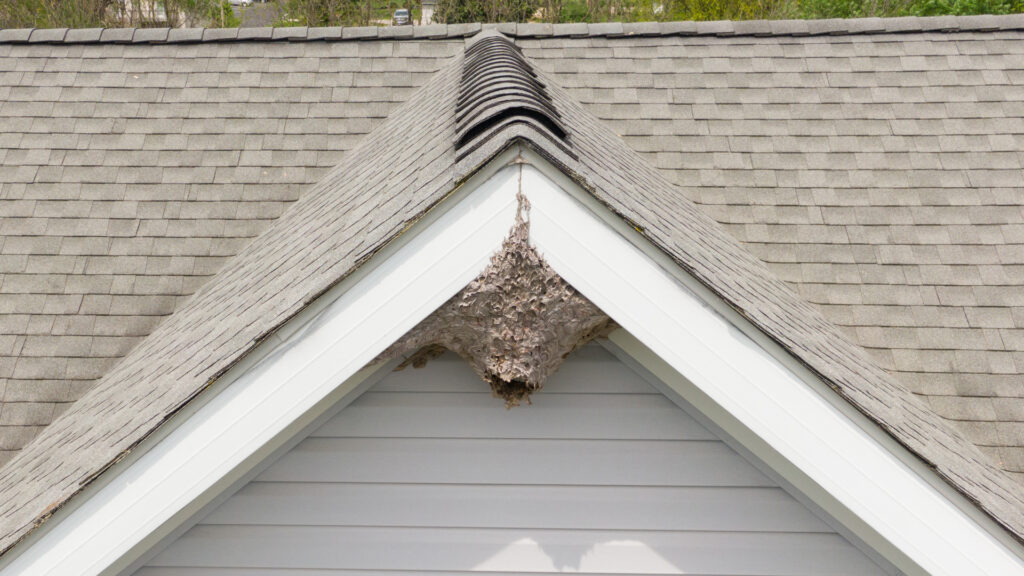
Wasp nests are made from chewed wood fiber mixed with saliva. That process gives them a papery, gray texture with a layered, slightly ridged surface, similar to papier-mâché: no wax, no honeycomb structure, no golden color.
If the nest you’re looking at has any of those features, it’s not wasps. A golf ball in spring, a football by August. Wasp nests grow fast, and the time of year you’re seeing them changes how alarming the size should be.
Paper, Aerial, and Ground Nests
-
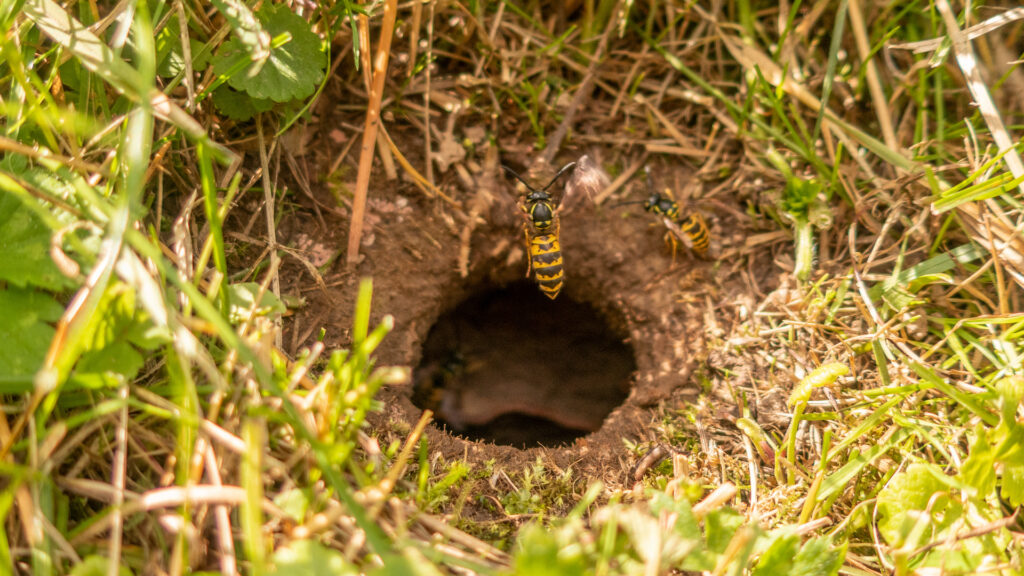
- Wasp ground nest
-
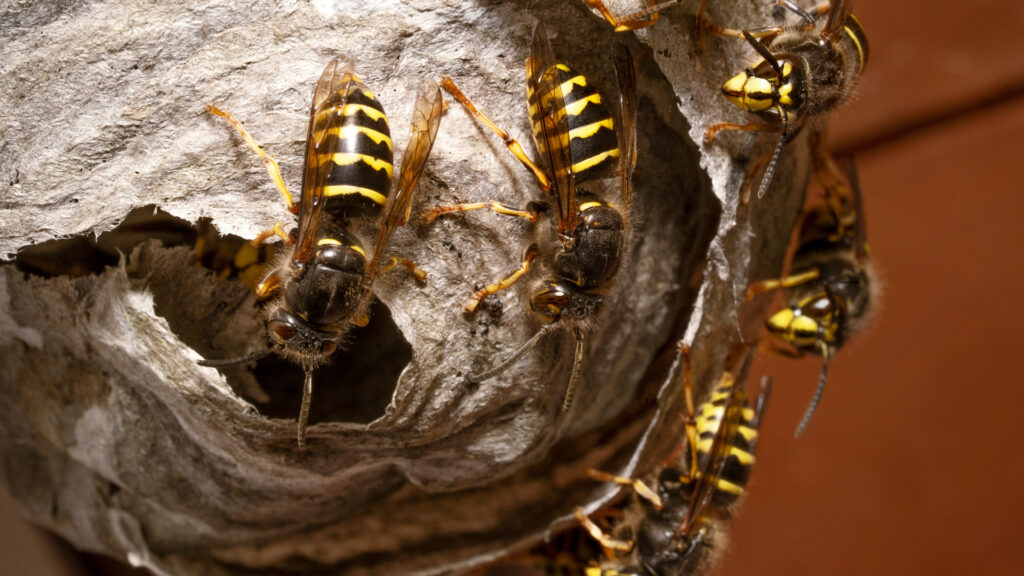
- Aerial paper wasp
The cells of a paper wasp nest are visible from below. The structure is open-comb, small, rarely larger than a hand, and found under eaves, in porch ceilings, or along fence rails. Paper wasps are relatively docile and will generally sting only if the nest is handled directly or the insect is cornered.
Aerial nests are the large enclosed gray paper balls built by bald-faced hornets. They hang from tree branches, roof overhangs, and occasionally from utility lines. They can reach the size of a basketball by late summer and house hundreds of workers.
Bald-faced hornets are aggressive defenders and will respond to movement or vibration near the nest. Don’t approach one to get a closer look.
Yellow jacket ground nests have no visible external structure. You’ll see a hole in the ground with wasps moving in and out at speed. The colony is underground and can hold thousands of workers. Ground nests are the most dangerous type to disturb.
The entry point is easy to step on or mow over accidentally. Our pest library covers wasp and hornet species in more detail if you need to narrow down what you’re looking at.
What Bee Nests Look Like
The variety here is wider than most people expect. Material, location, and size differ significantly across species, and the differences matter for how you respond.
Honeybees, Bumblebees, and Ground Nesters
-
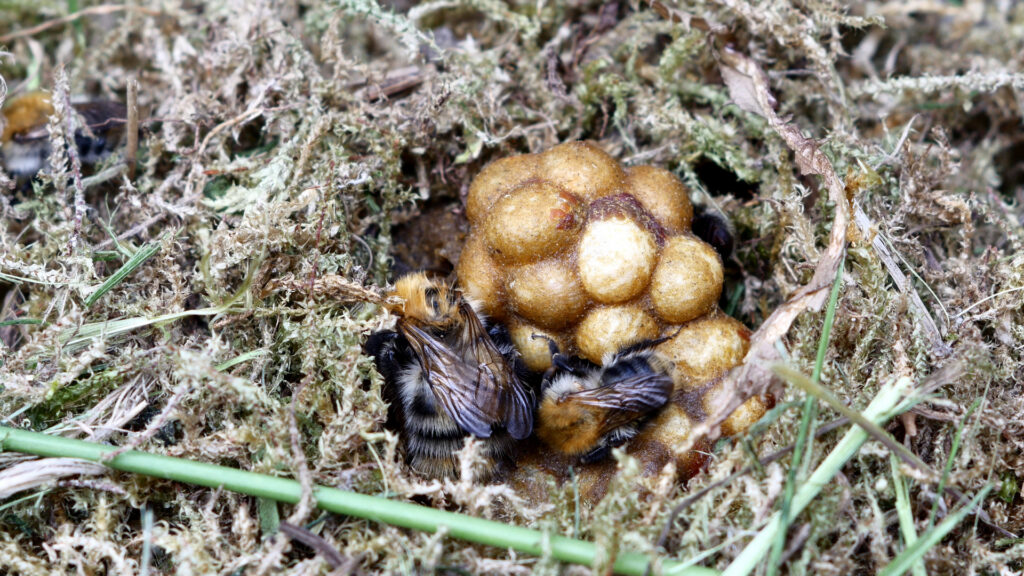
- Bumblebee nest
-
- Honeybee nest
-
- Bee creating ground nest
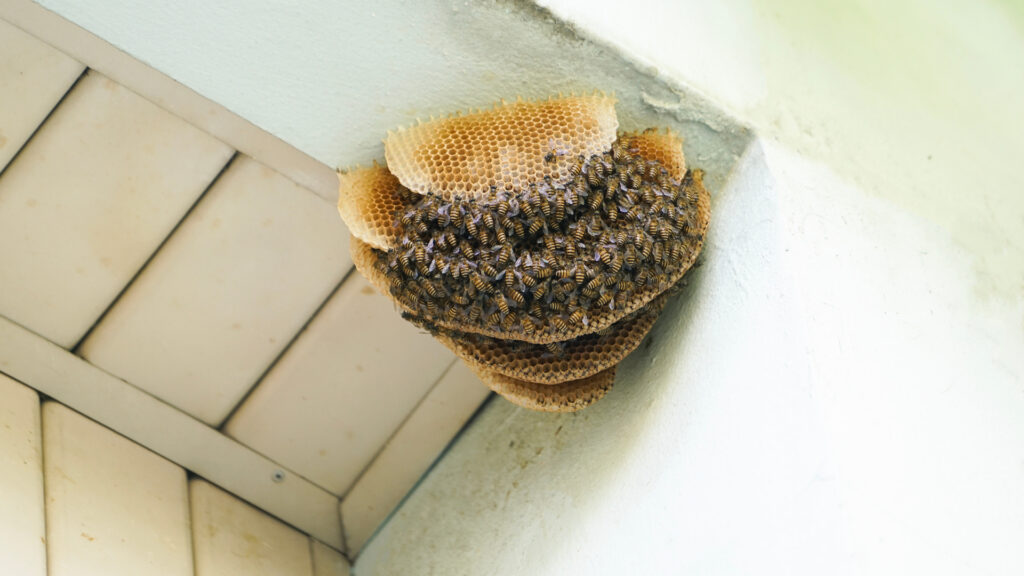
Honeybee colonies build with wax. Their combs have the familiar hexagonal cell structure and a yellowish or golden color.
Colonies nest inside enclosed cavities: hollow tree trunks, wall voids, attic spaces. You won’t see the comb itself unless the bees have built in an exposed location. What you’ll see instead is a steady stream of bees entering and exiting a gap, more traffic than you’d expect from a random entry point.
The most common bumblebee nest you’ll find is underground, usually in an old rodent burrow, under decking, or in a clump of dense grass. The nest is small and loosely constructed, holding fewer than 400 bees at peak. Bumblebees are unlikely to sting unless the nest is directly disturbed.
They’re important pollinators. Removal is rarely necessary unless the location makes accidental disturbance hard to avoid. If you’ve found one near a garden or in a low-traffic corner of the yard, it’s probably worth leaving it alone until the season ends.
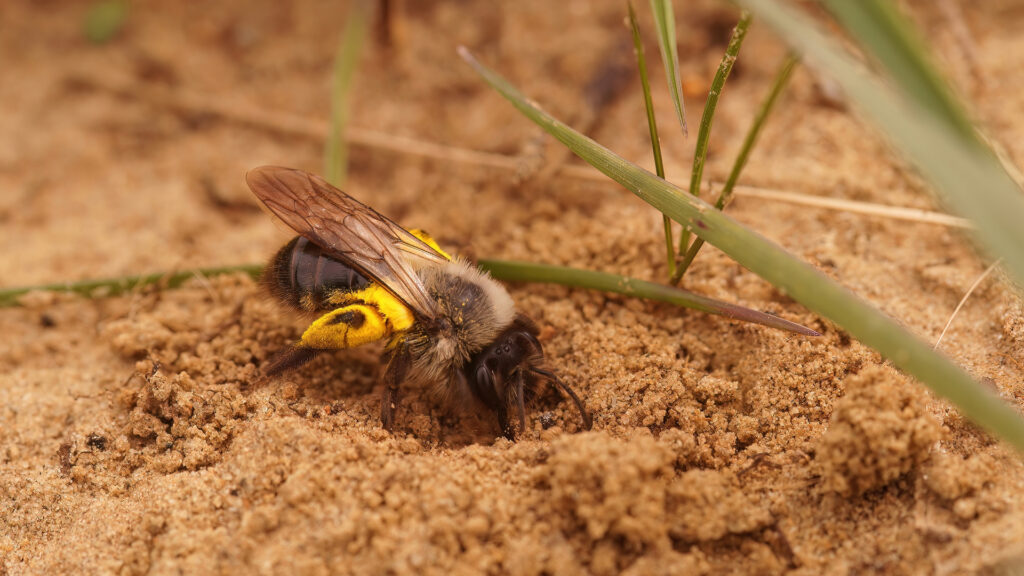
Small, round holes in a wooden surface or clusters of holes in bare soil indicate solitary bee activity. Mason bees and sweat bees nest individually rather than in colonies. There’s no group to defend and no meaningful sting risk.
Which One Needs a Pro
Yellow jacket ground nests, aerial hornet nests, and any wasp nest inside a wall or near a high-traffic entry point need professional treatment. The species and nest location determine the method, and the approach that works for paper wasps is not the same one that works for yellow jackets. Our residential pest control team identifies the species before treating.
Timing matters too. A yellow jacket nest in July holds a few hundred workers. The same nest in September can hold several thousand. A nest that seems manageable early in the season becomes a much more serious situation by late summer, which is when most people finally decide to do something about it.
Bee colonies are a different matter. Honeybee swarms and established colonies are best handled by a beekeeper who can relocate rather than destroy. Bumblebee nests in low-risk locations can be left until the colony naturally declines in fall. If you’re not sure what you’re looking at or where the nest is, call us before doing anything else.
Get Stinging Insect Control From proof.
If the nest is in or near your home and you’re not certain what you’re dealing with, don’t guess. A wrong call on species means a wrong call on treatment. That makes the situation harder to resolve. Getting it wrong means a defensive swarm at best and structural damage or repeat colonization at worst.
We handle wasp and hornet treatment directly. Call us at 888-291-5333 or visit our service areas page to find the office nearest you. We serve homeowners across: