

A tenant in a Levittown duplex sprays under the sink every Sunday like clockwork, and by Wednesday there’s a fresh one on the counter again. That’s not bad luck. German cockroaches are built to survive exactly that kind of routine, and Long Island’s older multi-family buildings give them every hiding spot they need to keep coming back.
How Fast German Roaches Reproduce
Thirty to forty nymphs come out of a single egg capsule, and a female produces one roughly every three weeks. That’s the number that makes German cockroaches different from almost everything else we treat for on Long Island.
A German cockroach reaches reproductive age in about six weeks, so by the time you notice the first one, you’re usually looking at the third or fourth generation already sharing the walls. Run that math over a full summer with no natural die-off and a single female’s line could theoretically number in the tens of thousands.
That’s the ceiling, not the reality. Real infestations never get there, since roaches compete for the same food and space. But it explains why a “small” problem in June is rarely still small by August.
Most German cockroach identification calls we get start the same way: someone found “a couple” and assumed that meant a couple. It rarely does.
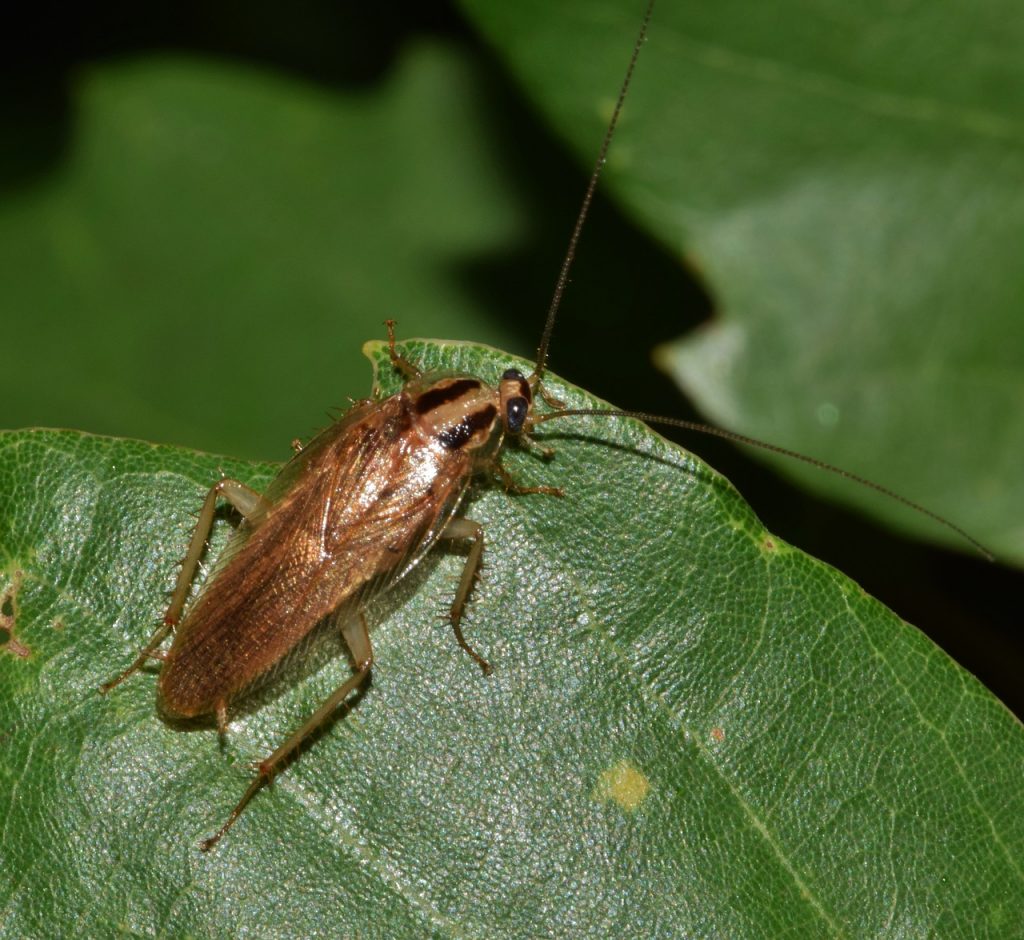
German cockroaches are light brown with two dark racing stripes running down from behind the head. They’re noticeably smaller than the American cockroaches people are used to seeing outdoors. And they rarely wander far from a reliable food and water source once they’ve found one.
That’s exactly why they show up in the same three or four spots in a kitchen instead of spreading through the whole apartment.
Egg Capsules and Hidden Nests
A few spots hold most of the eggs in a typical Long Island unit:
- Behind the refrigerator’s motor housing, where warmth keeps eggs viable through the winter
- Dishwasher control panels trap enough moisture underneath to matter
- Shared wall conduits between attached units, common in duplex and rowhouse construction
- Cabinet seams where the laminate has started to peel back from the particleboard
None of these spots get touched by a can of spray aimed at the counter. That’s the whole issue in one sentence.
Droppings Are the Clearest Warning Sign
Most people never see a live German cockroach before they see its droppings. The pellets look like black pepper or fine coffee grounds, usually a millimeter or two long, and fresh ones are dark brown to black before fading to a rusty reddish-brown with age.
A few dozen scattered along a cabinet seam or drawer track means a colony has been established there for a while, not that one roach passed through recently.
The spots where droppings collect track closely with where the roaches nest. Cabinet corners and drawer tracks are common. So is the space behind the fridge and under the dishwasher. Bathrooms collect every bit as much as kitchens do, especially behind the toilet and along the pipes under the sink.
Droppings serve as more than a detection tool. Skin rashes and nasal congestion are common in sensitive households for a documented reason: the proteins in German cockroach droppings and saliva are known allergens.
More sensitive people can also develop asthma-like respiratory symptoms. Roaches that crawl through drains and garbage on the same day they walk across a food prep surface also track Salmonella and E. coli with them. That’s part of why an infestation gets treated as a health issue, not merely a nuisance.
Why Store Sprays Rarely Work
Spray a German cockroach directly and it dies. That part works fine. The problem is everything the spray never touches, because contact killers only affect what they land on, and a nest tucked behind a dishwasher panel was never in the line of fire to begin with.
Bait products get around that limitation in theory. A roach eats the bait and carries some of it back to the nest on its body. Other roaches groom it or eat its droppings, and they die too. In practice, some German cockroach lines have developed a genetic aversion to the glucose used in older bait formulas.
This trait spread through wild populations decades ago once enough roaches carrying the mutation survived to reproduce. So the roaches simply avoid it. A “German cockroach killer” that worked at a neighbor’s place three years ago might do nothing here if the local population has already developed an aversion to it.
There’s no way to know which trait a given building’s roaches carry without watching how they respond to a first treatment.
Bait Resistance in Dense Housing
A few signs point to a population that’s already adapted to whatever’s been tried before:
- Roaches still active weeks after a visible spraying
- Even after repeated treatment, sightings stay clustered near the same outlets and baseboards
- Daytime activity, not only after the lights go off
- A neighbor treats their unit, and new activity shows up in yours within days
That last one matters a lot. Attached housing means a resistant population doesn’t stay contained to a single address. It moves through shared plumbing chases and wall cavities, just as water moves through a pipe.
Droppings Are the Clearest Warning Sign
Most people never see a live German cockroach before they see its droppings. The pellets look like black pepper or fine coffee grounds, usually a millimeter or two long, and fresh ones are dark brown to black before fading to a rusty reddish-brown with age.
A few dozen scattered along a cabinet seam or drawer track means a colony has been established there for a while, not that one roach passed through recently.
The spots where droppings collect track closely with where the roaches nest. Cabinet corners and drawer tracks are common. So is the space behind the fridge and under the dishwasher. Bathrooms collect every bit as much as kitchens do, especially behind the toilet and along the pipes under the sink.
Droppings serve as more than a detection tool. Skin rashes and nasal congestion are common in sensitive households for a documented reason: the proteins in German cockroach droppings and saliva are known allergens.
More sensitive people can also develop asthma-like respiratory symptoms. Roaches that crawl through drains and garbage on the same day they walk across a food prep surface also track Salmonella and E. coli with them. That’s part of why an infestation gets treated as a health issue, not merely a nuisance.
Why Store Sprays Rarely Work
Spray a German cockroach directly and it dies. That part works fine. The problem is everything the spray never touches, because contact killers only affect what they land on, and a nest tucked behind a dishwasher panel was never in the line of fire to begin with.
Bait products get around that limitation in theory. A roach eats the bait and carries some of it back to the nest on its body. Other roaches groom it or eat its droppings, and they die too. In practice, some German cockroach lines have developed a genetic aversion to the glucose used in older bait formulas.
This trait spread through wild populations decades ago once enough roaches carrying the mutation survived to reproduce. So the roaches simply avoid it. A “German cockroach killer” that worked at a neighbor’s place three years ago might do nothing here if the local population has already developed an aversion to it.
There’s no way to know which trait a given building’s roaches carry without watching how they respond to a first treatment.
Bait Resistance in Dense Housing
A few signs point to a population that’s already adapted to whatever’s been tried before:
- Roaches still active weeks after a visible spraying
- Even after repeated treatment, sightings stay clustered near the same outlets and baseboards
- Daytime activity, not only after the lights go off
- A neighbor treats their unit, and new activity shows up in yours within days
That last one matters a lot. Attached housing means a resistant population doesn’t stay contained to a single address. It moves through shared plumbing chases and wall cavities, just as water moves through a pipe.
Breaking the Infestation Cycle
Killing the roaches you can see solves the problem for about three weeks, until the eggs already laid hatch. That’s the part most roach infestation signs point to without people realizing it. What looks like a treatment that “didn’t work” is often one that worked exactly as expected, though not long enough to reach the next generation.
Long Island’s older rental buildings and co-ops make this worse. Turnover means no one has a full treatment history for the unit, and a new tenant is effectively inheriting whatever population survived each previous attempt.
What a Real Treatment Plan Covers
An insect growth regulator is what actually closes that gap, since it stops nymphs from reaching reproductive age even after they hatch. Paired with a non-repellent product roaches can’t detect and a bait rotation that accounts for aversion, most Long Island infestations break within two to three visits rather than dragging out for months. That’s the target, not a guess.
Our residential roach treatment service checks the spots that matter most on the follow-up visit, the ones behind appliances and inside cabinet seams, rather than just the kitchen counter where the roaches happened to be seen.
This is a dedicated two-visit treatment, not part of our recurring seasonal plan. The first visit includes a full inspection inside and out along with a foundation treatment, and the interior gets treated too. The second visit follows up on that work, catching any rebound in activity before it turns into a full reinfestation.
proof.’s German Roach Treatment Plan
If you’ve sprayed under every sink and cleaned out half the pantry and the roaches are still showing up, that’s not a sign you’ve done something wrong. It’s a sign the nest was never in the treatment’s path to begin with.
Give us a call at 888-291-5333 or reach out through our contact page, and we’ll build a plan around where these roaches are actually breeding, not just where they’ve been spotted.
proof. handles German roach and cockroach treatment in our service areas, including: